Nuria Fernández
In the dynamic business landscape of 2026, environmental, health, and safety (EHS) management has evolved from being a mere regulatory obligation to becoming a fundamental strategic pillar for the success and sustainability of organizations. Companies that prioritize the well-being of their employees, the protection of the planet, and regulatory compliance not only minimize risks and avoid penalties but also strengthen their reputation, attract talent, and optimize their operations. In this context, technology solutions play a crucial role, and SAP EHSM (Environment, Health, and Safety Management) emerges as an undisputed leader, offering a robust and unified platform to address these complex challenges.
But what exactly is SAP EHSM, and why has it become so vital for modern businesses? Essentially, SAP EHSM is an integrated software suite within the SAP ecosystem, designed to help organizations proactively and efficiently manage all aspects related to safety, occupational health, and environmental management. It goes far beyond simply recording incidents; it is a holistic tool that enables companies to identify, assess, control, and monitor risks, ensure regulatory compliance, optimize safety processes, manage the product lifecycle securely, and foster a culture of prevention throughout the organization.
The complexity of global EHS regulations—which are constantly evolving and vary significantly across industries and regions—poses a considerable challenge. According to a recent report by the consulting firm Global EHS Insights, the cost of regulatory noncompliance for companies can amount to millions of euros annually, not to mention the damage to reputation and the loss of stakeholder trust. [1] SAP EHSM addresses this complexity by providing a standardized and adaptable framework that helps companies stay current with existing regulations and anticipate future changes.
The integration of SAP EHSM with other SAP modules, such as SAP S/4HANA, SAP SuccessFactors, and SAP Analytics Cloud, provides a 360-degree view of operations and risks. This synergy facilitates data-driven decision-making, process automation, and continuous improvement in EHS performance. It is no longer a matter of managing EHS in a silo, but rather of integrating it into the very fabric of business strategy.
Throughout this article, we will take an in-depth look at what SAP EHSM is, its main modules, its key benefits, how it integrates with other SAP solutions, and why adopting it is essential for any company striving for operational excellence and sustainability in 2026 and beyond.
Key Components of SAP EHSM
The power of SAP EHSM lies in its modular architecture, which allows companies to select and implement the features that best suit their specific needs. While the suite has evolved and may have different configurations depending on the version and SAP updates, the core components typically cover the following critical areas:
Incident and Action Management
This module is essential for recording, investigating, and managing any adverse event, from workplace accidents and near misses to environmental incidents. It allows you to document incident details, identify root causes, assign responsibilities for corrective and preventive actions, and track progress until the incident is closed. The ability to analyze incident trends helps identify high-risk areas and implement proactive measures to prevent future occurrences. Agility in incident response and management is crucial for minimizing the impact and learning from each event.
Product Management (Product Compliance)
In a world increasingly focused on product safety and environmental impact, product compliance management is essential. This component of SAP EHSM helps companies ensure that their products comply with regulations governing chemical safety, labeling, transportation, and disposal in the markets where they operate. It includes features for managing safety data sheets (SDS), classifying and labeling hazardous substances and mixtures, and compliance with regulations such as REACH (Registration, Evaluation, Authorization, and Restriction of Chemicals) in Europe or TSCA (Toxic Substances Control Act) in the United States. Proper management of the product lifecycle—from design through disposal—is key to avoiding legal and reputational risks.
Occupational Health Management
Employee health and well-being are top priorities. This module focuses on preventing occupational illnesses and promoting health in the workplace. It allows you to manage occupational health exams, track employees’ fitness for specific tasks, administer vaccinations, manage occupational health records, and monitor exposure to hazardous agents. Integration with human resources systems, such as SAP SuccessFactors, can facilitate the assignment of employees to health programs and the management of sick leave.
Process Safety Management
For industries with high-risk operations, such as the chemical, petrochemical, or heavy manufacturing sectors, process safety management is vital. This component helps identify, assess, and control the risks associated with processes involving hazardous substances. It enables the management of Hazard and Operability Studies (HAZOP), Process Hazard Assessments (PHA), work permits, change management (MOC), and safety audits. The goal is to prevent catastrophic incidents that could have devastating consequences for people, the environment, and business continuity.
Hazardous Substance Management
This module focuses on the control and safe management of all hazardous substances used or produced by the company. It includes the creation and maintenance of substance inventories, the management of their physicochemical and toxicological properties, the definition of storage and handling requirements, and the generation of relevant safety documentation. The proper classification and labeling of these substances is crucial for preventing accidents and ensuring regulatory compliance.
Environmental Management
This component addresses the management of the environmental aspects of business operations. It enables companies to monitor and report emissions (air, water, soil), manage waste, control resource consumption (water, energy), and ensure compliance with local and international environmental regulations. The ability to track environmental impact and implement sustainability initiatives is increasingly important for corporate reputation and ESG (Environmental, Social, and Governance) investing.
Audits and Assessments
Auditing and continuous assessment are essential for verifying the effectiveness of EHS management systems and for identifying areas for improvement. This module facilitates the planning, execution, and follow-up of internal and external audits, safety inspections, risk assessments, and compliance reviews. It allows you to document findings, assign corrective actions, and generate reports for senior management.
Benefits of Implementing SAP EHSM
The adoption of SAP EHSM goes beyond the simple digitization of EHS processes; it represents a strategic transformation that offers tangible and far-reaching benefits for organizations:
Guaranteed Regulatory Compliance
One of the most immediate and crucial benefits is the ability to comply with an increasingly complex and ever-changing regulatory landscape. SAP EHSM provides the tools and framework to ensure that companies operate within legal and regulatory boundaries in all jurisdictions where they have a presence. This significantly reduces the risk of fines, penalties, and litigation. According to the European Chemicals Agency (ECHA), noncompliance with regulations such as REACH can result in substantial financial penalties and trade restrictions.
Risk and Cost Reduction
By enabling proactive management of safety, health, and environmental risks, SAP EHSM helps prevent incidents, accidents, and work-related illnesses. Fewer incidents directly translate into lower costs associated with compensation, sick leave, damage repairs, production downtime, and lower insurance premiums. Prevention is undoubtedly the most cost-effective strategy in the EHS field.
Improving Corporate Reputation and Sustainability
Companies that demonstrate a strong commitment to safety, health, and the environment build a positive reputation among their employees, customers, investors, and the community at large. Effective EHS management, enabled by solutions such as SAP EHSM, directly contributes to sustainability goals and ESG metrics, which are increasingly valued by financial markets and consumers. A 2023 PwC report highlighted that 70% of investors consider ESG factors to be important in their investment decisions.
Process Optimization and Operational Efficiency
The automation of routine tasks, the standardization of processes, and the data integration provided by SAP EHSM free up time and resources for EHS staff, allowing them to focus on activities of greater strategic value, such as continuous improvement and risk management. The centralization of EHS information facilitates rapid access and informed decision-making.
Employee Safety and Well-Being
By placing a strong emphasis on occupational health and accident prevention, SAP EHSM directly contributes to creating a safer and healthier work environment. This not only protects employees but also improves morale, productivity, and talent retention. A study conducted by the International Labor Organization (ILO) highlights the direct correlation between safe work environments and economic productivity.
Comprehensive Product Lifecycle Management
For companies that manufacture or distribute products, SAP EHSM provides a comprehensive view of safety and compliance throughout the entire product lifecycle. From formulation and labeling to transportation and final disposal, the solution helps ensure that products are safe for users and comply with all applicable regulations, minimizing the risk of product recalls or legal issues.
Data-Driven Decision Making
SAP EHSM’s ability to centrally collect, analyze, and report EHS data provides management with the visibility needed to make informed strategic decisions. Interactive dashboards and customizable reports make it possible to identify trends, evaluate the effectiveness of EHS initiatives, and allocate resources more efficiently.
Integration with the SAP ecosystem
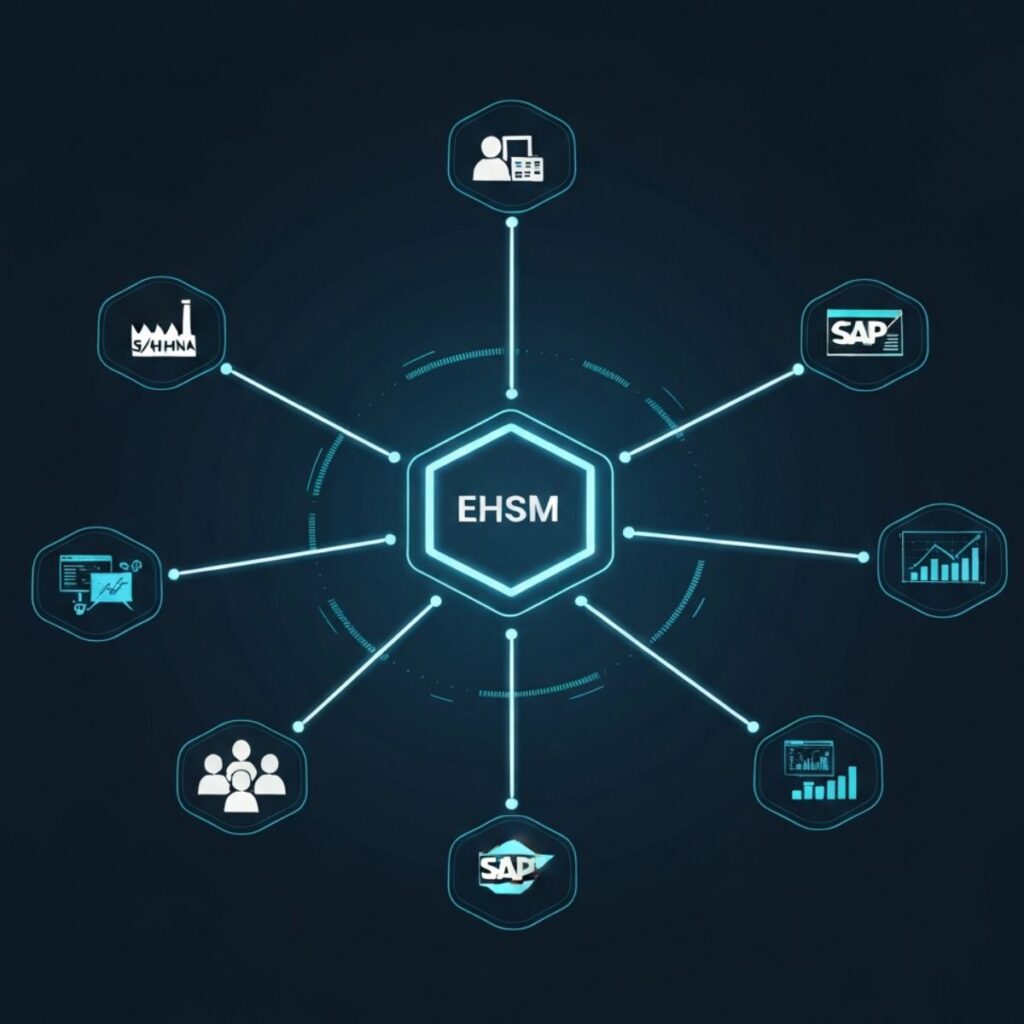
One of SAP EHSM’s most significant strengths is its ability to integrate seamlessly with other SAP solutions, creating a cohesive and highly efficient business ecosystem. This integration goes beyond simple data sharing; it enables the orchestration of end-to-end business processes, where EHS information becomes an integral part of operational and strategic decisions.
SAP S/4HANA
Integration with SAP S/4HANA, SAP’s next-generation enterprise management platform, is essential. It enables EHS data to be aligned with core business processes, such as supply chain management, production, maintenance, and finance. For example, data on hazardous substance management can be integrated with S/4HANA’s inventory management to ensure that materials are stored and handled in accordance with safety regulations. Similarly, incidents related to machinery safety can be linked to maintenance modules to schedule repairs and prevent recurrences. This synergy ensures that EHS considerations are embedded in daily operations.
SAP SuccessFactors
Integration with SAP SuccessFactors, the cloud-based human capital management solution, is crucial for managing occupational health and training. It allows employee health records to be linked to their profiles in SuccessFactors, facilitating the management of medical exams, wellness programs, and tracking of sick leave. In addition, EHS training needs can be identified and assigned through the SuccessFactors learning management platform, ensuring that employees receive the appropriate training to perform their duties safely.
SAP Analytics Cloud (SAC)
SAP Analytics Cloud is a powerful tool for data visualization and analysis. When integrated with SAP EHSM, it enables companies to create interactive dashboards and generate advanced reports on EHS performance. This makes it easier to identify trends, evaluate the effectiveness of risk control measures, track KPIs (Key Performance Indicators), and communicate EHS progress to senior management and other stakeholders. The ability to perform predictive analytics on incidents or potential risks is a significant step forward for proactive management.
SAP Integrated Business Planning (IBP)
For companies looking to optimize their supply chain, integration with SAP IBP can be beneficial. It allows companies to factor in EHS risks when planning demand and supply—for example, by assessing the impact of environmental regulations on material availability or the logistics costs associated with transporting hazardous substances.
SAP EHSM’s deep integration with the SAP ecosystem enables companies to transition from reactive EHS management to a truly integrated and proactive approach, where safety, health, and sustainability are essential components of the overall business strategy.
Implementation and Key Considerations
The implementation of SAP EHSM is a major project that requires careful planning, adequate resources, and a thorough understanding of the organization’s specific needs. While the benefits are substantial, success depends on several key factors:
Clear Definition of Objectives and Scope
Before beginning the implementation, it is essential to clearly define the objectives you aim to achieve with SAP EHSM. Are you looking to improve regulatory compliance, reduce incidents, optimize product management, or a combination of these? Defining the scope of the project—including identifying priority modules and features—is crucial for a successful and controlled implementation.
Commitment from Senior Management
Support and commitment from senior management are essential. The transformation toward an integrated EHS culture requires leadership, the allocation of resources, and promoting the importance of safety and sustainability throughout the organization.
Change Management and Training
Implementing a new technology solution—especially one as comprehensive as SAP EHSM—involves changes to work processes and the way employees perform their tasks. A robust change management strategy—including clear communication, user engagement, and comprehensive training programs—is essential to ensuring the system’s adoption and effective use. Users must understand not only how to use the tool but also why it is important.
Choosing the Right Partner
Many organizations choose to work with implementation partners who specialize in SAP EHSM. Selecting a partner with proven experience, in-depth knowledge of the solution, and an understanding of the company’s industry is crucial to the project’s success.
Iterative Approach and Continuous Improvement
The implementation of SAP EHSM should not be viewed as a one-time event, but rather as an ongoing process. Adopting an iterative approach—starting with the most critical functionalities and gradually expanding the use of the solution—can be more manageable and effective. User feedback and EHS performance analysis should guide continuous improvement efforts.
Data Governance and Quality
The reliability of EHS information is paramount. Establishing clear processes for data entry, validation, and governance ensures that the information used for decision-making is accurate and reliable.
The Future of EHSM with SAP
The EHS management landscape is constantly evolving, driven by technological advances, stricter regulations, and a growing awareness of sustainability. SAP EHSM is positioned to lead this transformation, adapting and innovating to meet future needs.
Artificial intelligence (AI) and machine learning (ML) are beginning to play a more significant role in EHS management. These technologies can be used to predict risks, identify hidden patterns in incident data, automate the classification of hazardous substances, and even optimize prevention strategies. SAP is investing in these capabilities to further enhance the intelligence of its EHSM solutions.
The growing importance of ESG (Environmental, Social, and Governance) criteria is also driving demand for more sophisticated EHSM solutions. Companies need not only to comply with regulations but also to measure, manage, and report their impact in these areas transparently to investors, customers, and other stakeholders. SAP EHSM provides the platform to collect the necessary data and generate the reports required for corporate sustainability.
Connectivity and the Internet of Things (IoT) open up new possibilities for real-time monitoring of working conditions and environmental parameters. Sensors in machinery, in the work environment, or in products can send data directly to SAP EHSM, enabling a faster response to deviations or unsafe conditions.
In short, SAP EHSM is not just a tool for managing safety, health, and the environment today; it is a strategic platform that enables companies to navigate current and future complexities, build resilience, drive sustainability, and ensure a safer and healthier future for everyone.
Conclusion
By 2026, effective management of safety, health, and the environment will no longer be an option but a strategic necessity for business survival and success. SAP EHSM stands out as a leading solution that enables organizations to address this complexity in a comprehensive and proactive manner. From ensuring regulatory compliance and reducing risks to enhancing corporate reputation and promoting employee well-being, the benefits of implementing SAP EHSM are profound and far-reaching.
Integrating this powerful suite with the broader SAP ecosystem—such as SAP S/4HANA and SAP SuccessFactors—unlocks synergies that optimize operations and facilitate data-driven decision-making. While implementation requires careful planning and organizational commitment, companies that invest in SAP EHSM are investing in their future: a safer, more sustainable, and more successful future. Adopting SAP EHSM is a decisive step toward operational excellence and corporate responsibility in the digital age.
Frequently Asked Questions About SAP EHSM
What is SAP EHSM, and what is it used for?
SAP EHSM (Environment, Health, and Safety Management) is an integrated software suite from SAP designed to help companies comprehensively and proactively manage all aspects related to safety, occupational health, and environmental management. Its purpose is to enable organizations to identify, assess, control, and monitor risks; ensure regulatory compliance; optimize safety processes; manage the product lifecycle safely; and foster a culture of prevention.
What are the main modules of SAP EHSM?
The main modules of SAP EHSM typically include Incident and Action Management, Product Management (Product Compliance), Occupational Health Management, Process Safety Management, Hazardous Substances Management, Environmental Management, and Audits and Assessments. The exact configuration may vary depending on the version and the company’s needs.
How does SAP EHSM integrate with other SAP solutions?
SAP EHSM integrates natively with other key SAP solutions, such as SAP S/4HANA (to align EHS with core business processes such as supply chain and production), SAP SuccessFactors (for occupational health management and employee training), and SAP Analytics Cloud (for advanced analysis and visualization of EHS data). This integration enables a holistic view and end-to-end process automation.
Is SAP EHSM suitable for all industries?
While SAP EHSM is particularly valuable for industries with high EHS risks (such as chemicals, manufacturing, energy, and pharmaceuticals), its modularity and flexibility make it adaptable to a wide range of sectors. Companies in any industry that need to manage regulatory compliance, employee safety, or environmental impact can benefit from implementing SAP EHSM.
What are the key benefits of implementing SAP EHSM?
Key benefits include ensuring regulatory compliance, reducing risks and operating costs, enhancing corporate reputation and sustainability, optimizing EHS processes, improving employee well-being, and enabling more informed decision-making through data visibility.
What does it take to successfully implement SAP EHSM?
Successful implementation of SAP EHSM requires a clear definition of objectives and scope, commitment from senior management, a solid change management and training strategy, the selection of an experienced implementation partner, an iterative approach with continuous improvement, and robust data governance.