Patricia Martínez Ruiz
The confusion is understandable, but dangerous. In recent years, companies have had to navigate SII, TicketBAI, Batuz, Veri*Factu, and now B2B electronic invoicing under the Crea y Crece Law. All of these systems relate to invoicing, tax compliance, or invoice records. But they are not the same thing.
And if a company treats them as if they were interchangeable parts, it may make the wrong technical decisions.
The B2B electronic invoicing system governs the relationship between businesses and professionals regarding the issuance, transmission, and receipt of electronic invoices, as well as the reporting of certain invoice statuses, such as acceptance, rejection, or payment. Royal Decree 238/2026 establishes the Spanish system for mandatory electronic invoicing between businesses and professionals, covering private platforms, public solutions, and hybrid models.
Veri*Factu, on the other hand, focuses on the requirements for computerized invoicing systems: how invoicing records are generated, recorded, stored, or transmitted to ensure integrity, traceability, and protection against tampering. The Tax Agency explains that there are various compliance methods, including the VERI*FACTU method, in which records are submitted to the AEAT’s Electronic Office immediately after they are generated.
The SII is something else entirely: a system for the electronic submission of invoice records for the management of VAT ledgers through the AEAT.
And TicketBAI, within the context of the Basque regional tax authorities, relies on the generation of electronically signed files and invoices that include elements such as a QR code and the TicketBAI identifier. In Bizkaia, Batuz also connects to the Economic Transactions Register.
That’s why this issue can’t be resolved with a simple statement like “we’ve already got electronic invoicing covered.” We need to look at which requirement we’re meeting, which system is affected, and which SAP process is involved.
The Essential Difference: Audience, Objective, and Process
The clearest way to distinguish between these obligations is to ask yourself three questions: Who is the information intended for? What is its purpose? And at what point in the process does it have an impact?
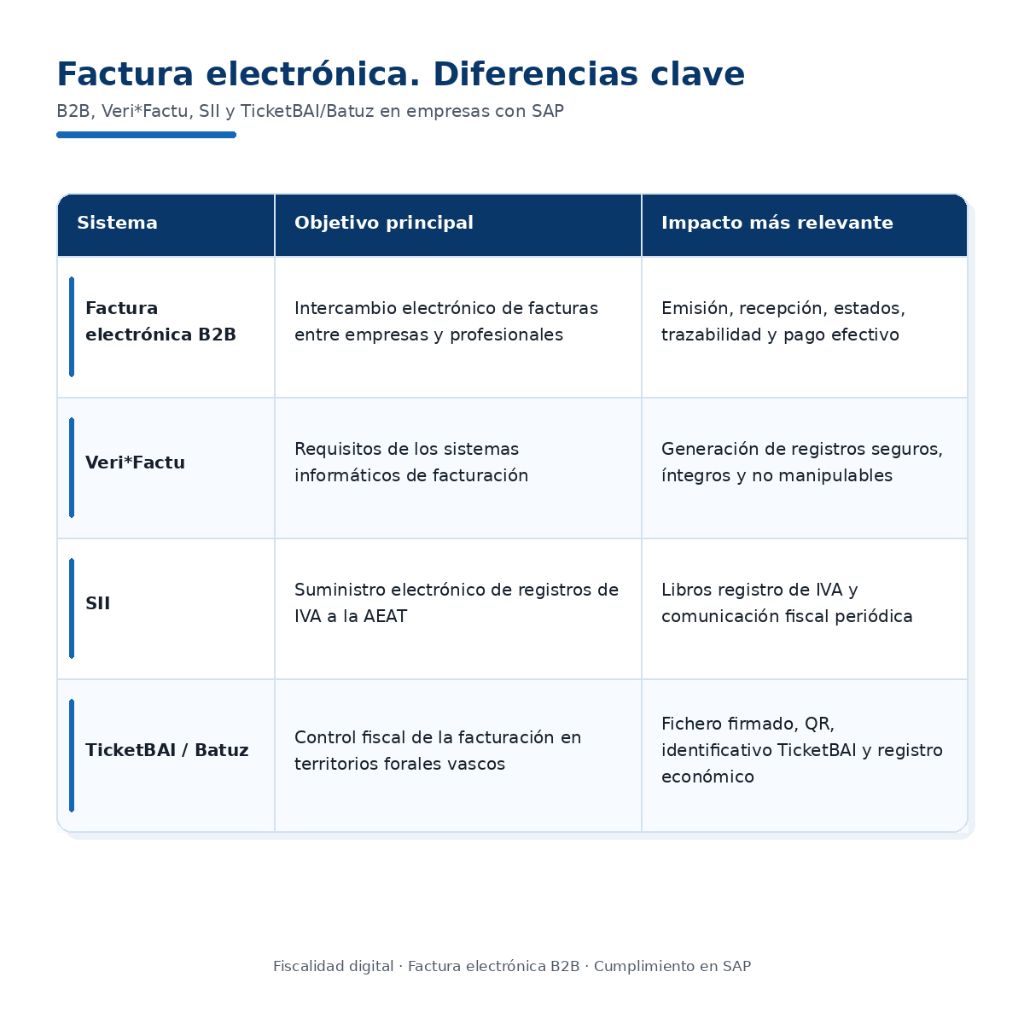
The table makes clear something that many organizations have not yet fully grasped: these obligations can coexist, overlap in some data, and share part of the architecture, but they do not replace one another.
A company may have its SII compliance in order but not yet have its B2B electronic invoicing system set up. It may have been using TicketBAI and need to review its invoice receipt process. It may have adapted its systems to Veri*Factu and still not have the process for accepting, rejecting, or making actual payments set up in the new B2B system.
If your company has already used SII, TicketBAI, Batuz, or Veri*Factu, don’t assume that B2B electronic invoicing is covered. It’s a good idea to review the complete overview of SAP obligations and processes.
B2B Electronic Invoicing. The leap lies in the entire cycle
B2B electronic invoicing is not limited to generating a structured document. The significant change lies in the entire invoice cycle: issuance, receipt, communication, acceptance, rejection, payment, and traceability.
Royal Decree 238/2026 provides for the reporting of statuses such as commercial acceptance or rejection and full payment. It also provides for additional statuses such as partial acceptance, partial rejection, partial payment, or assignment of the invoice.
This changes the nature of the project. We’re no longer just talking about the moment the invoice is issued by Sales. We’re also talking about how Purchasing validates a received invoice, how Accounts Payable records a discrepancy, how Treasury identifies the actual payment date, and how all that information is linked to SAP.
In a company with complex processes, that information isn’t always organized. It may be scattered across different modules, in in-house systems, in external approvals, in databases, in document management systems, or even in emails. If this fragmentation isn’t addressed, electronic invoicing can become an additional layer of complexity.
Veri*Factu: Focus on the system that generates the invoice
Veri*Factu highlights a different issue: the integrity of computer-based invoicing systems. The AEAT itself links this framework to the Regulation approved by Royal Decree 1007/2023, which sets forth the requirements that must be met by computer or electronic systems and software supporting the invoicing processes of businesses and professionals.
The question here is not so much how an invoice is transmitted between two companies, but rather whether the system that generates it meets the requirements for recording, retention, traceability, and non-alteration.
In SAP terms, this requires a review of how invoicing documents are generated, which systems are involved, what custom developments exist, and how the traceability of the record is ensured. However, it should not be confused with a comprehensive B2B exchange solution between customer and supplier.
To put it bluntly: Veri*Factu is not the B2B electronic invoice required by the Crea y Crece Act. It may be part of the compliance framework, but it operates on a different basis.
SII. VAT ledgers, non-B2B transactions
The SII was one of the major precursors to tax digitization in Spain. The AEAT defines it as the electronic submission of invoicing records through its electronic portal, including procedures such as the registration of invoices issued and received.
For many companies using SAP, the SII has already required them to organize tax data, automate communications, and control submission errors. That experience is valuable. But it should not lead to a false conclusion.
Having SII implemented does not mean that B2B electronic invoicing has been resolved.
The SII focuses primarily on the tax administration and VAT records. B2B electronic invoicing introduces an additional dimension: the operational relationship between companies, the receipt of invoices, commercial statements, actual payment, and interoperability between platforms or with the public solution.
Previous experience with SII is helpful. But it is no substitute for a new analysis.
TicketBAI and Batuz: A Useful Experience, but Not Equivalent
For i3s, the experience gained at TicketBAI and Batuz is particularly relevant because it demonstrates the ability to execute complex tax projects in SAP environments. However, it is important not to market that experience in a vague manner.
TicketBAI and Batuz have required many organizations to work with files, digital signatures, QR codes, identifiers, records, and communication with regional tax authorities. That experience provides highly valuable technical and operational knowledge. However, B2B electronic invoicing adds another layer: the exchange of invoices between companies and the management of subsequent invoice statuses.
The advantage for a company that has already used TicketBAI, Batuz, or SII is that it isn’t starting from scratch. It already understands the importance of master data, monitoring, error management, integration with SAP, and the need for specialized support.
But the new project shouldn’t simply be copied. It must be designed with the B2B process in mind.
i3s can help you apply what you’ve learned from SII, TicketBAI, Batuz, or Veri*Factu without confusing them with the new B2B electronic invoicing architecture.
What Should a Company Using SAP Review?
The first task is to create a realistic map of tax compliance and billing. It’s not enough to simply list the solutions that have been implemented. You need to understand which regulatory requirement each one addresses, which processes it affects, and what information is generated in SAP.
That assessment should address specific questions: which companies are affected, which systems generate invoices, which channels receive invoices from suppliers, how are rejected invoices handled, who reports payments, where is traceability maintained, and which integrations are critical.
It is also worth examining whether there are standalone solutions that address a specific requirement but result in duplication. The goal should not be to pile up layers of technology, but rather to build a coherent tax and financial architecture.
Before adapting your system to B2B electronic invoicing, request a review of your current ecosystem: SII, TicketBAI, Batuz, Veri*Factu, SAP, integrations, and financial processes.
B2B electronic invoicing, Veri*Factu, SII, and TicketBAI are all part of the same underlying trend: the digitization of tax compliance and invoicing. However, they are not the same requirement, they are not intended for the same audience, and they do not have the same impact on a company’s processes.
For an organization using SAP, this difference is critical. If the systems are confused, there is a risk of choosing an incomplete solution, duplicating processes, losing traceability, or leaving out key areas such as Purchasing, Accounts Payable, or Treasury.
The right approach starts with mapping things out: what we have, what each system covers, what still needs to be adapted, and how everything should be integrated into a sustainable SAP architecture.
i3s can add value precisely in this area: by combining expertise in digital taxation, knowledge of SAP processes, and the ability to support companies that need to comply without disrupting their operations