Patricia Martínez Ruiz
The “Crea y Crece” Electronic Invoicing Law marks a significant change for Spanish companies: B2B electronic invoicing is no longer a voluntary digitization initiative but has become part of the mandatory framework governing business-to-business transactions. Law 56/2007, as amended by Law 18/2022, stipulates that all businesses and professionals must issue, send, and receive electronic invoices in their B2B commercial transactions, in addition to providing information on the status of the invoices.
But to stop at that sentence would be a mistake—and a pretty serious one at that.
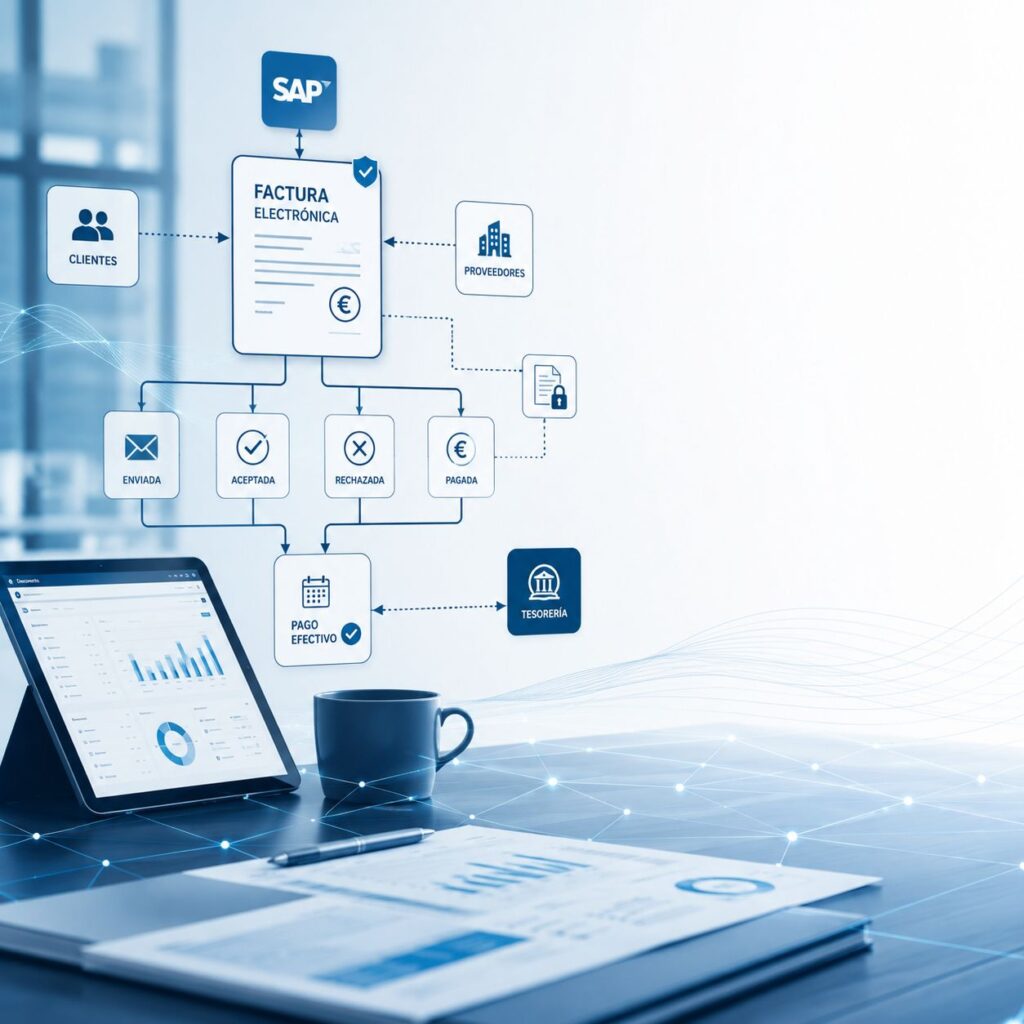
For a company that uses SAP ECC or SAP S/4HANA, B2B electronic invoicing is not just a matter of format, signature, or delivery. It affects how invoices are generated, received, validated, accepted, rejected, paid, and tracked within the system. In other words: we’re not just talking about invoicing. We’re talking about financial processes, purchasing, sales, treasury, master data, integrations, and regulatory compliance.
That’s the point that many organizations are underestimating.
What Has Been Approved and What Needs to Be Monitored
Key components of the regulatory framework have already been approved. Royal Decree 238/2026 establishes the Spanish system for mandatory electronic invoicing between businesses and professionals, including technical requirements, information requirements, private exchange platforms, and a public solution. The Tax Agency has also announced that this Royal Decree sets forth the technical and information requirements for the Spanish mandatory B2B electronic invoicing system.
However, the effective implementation of the system is contingent upon the entry into force of the Ministerial Order that is to establish the public electronic invoicing solution. The Royal Decree itself states that the deadlines will begin to run from the effective date of that Order: twelve months for businesses and professionals whose transaction volume exceeds 8 million euros, and twenty-four months for all others.
This requires precise communication. It is not accurate to simply say, “It’s already mandatory for everyone,” without any nuance. Nor is it wise to wait until everything is finalized before getting started. The window for preparation is already open, because internal changes cannot be resolved with a last-minute technical rollout.
i3s can help identify which FI, MM, SD, Accounts Payable, Accounts Receivable, and Treasury processes should be reviewed before implementing or adapting a B2B electronic invoicing solution.
Manage the entire invoice cycle
B2B electronic invoicing doesn’t end when an invoice is issued from SAP. That approach is far too limited for what lies ahead.
Royal Decree 238/2026 establishes the requirement to report certain statuses of electronic invoices, including commercial acceptance or rejection and full payment, along with the actual payment date. It also covers additional statuses such as partial acceptance, partial rejection, partial payment, or assignment of the invoice. Furthermore, information regarding these statuses must be submitted within a maximum of four calendar days—excluding Saturdays, Sundays, and national holidays—from the time the corresponding status occurs.
This changes the conversation.
A company can issue an electronic invoice correctly and still run into problems if it doesn’t know how to manage the subsequent steps in an integrated manner. Who validates the received invoice? How is a rejection recorded? Where is a commercial discrepancy documented? How is the actual payment linked to the Treasury department? What happens when there are partial payments? How can you prevent part of the process from being handled outside of SAP via email, Excel spreadsheets, or manual tasks?
That’s where the real risk lies: formally complying with the issuance requirements but losing control over management.
Impact on SAP: Processes, Data, and Integrations
In SAP environments, compliance with the Crea y Crece Act must be analyzed from an end-to-end perspective. It is not enough to simply connect an external platform and assume that the problem is solved.
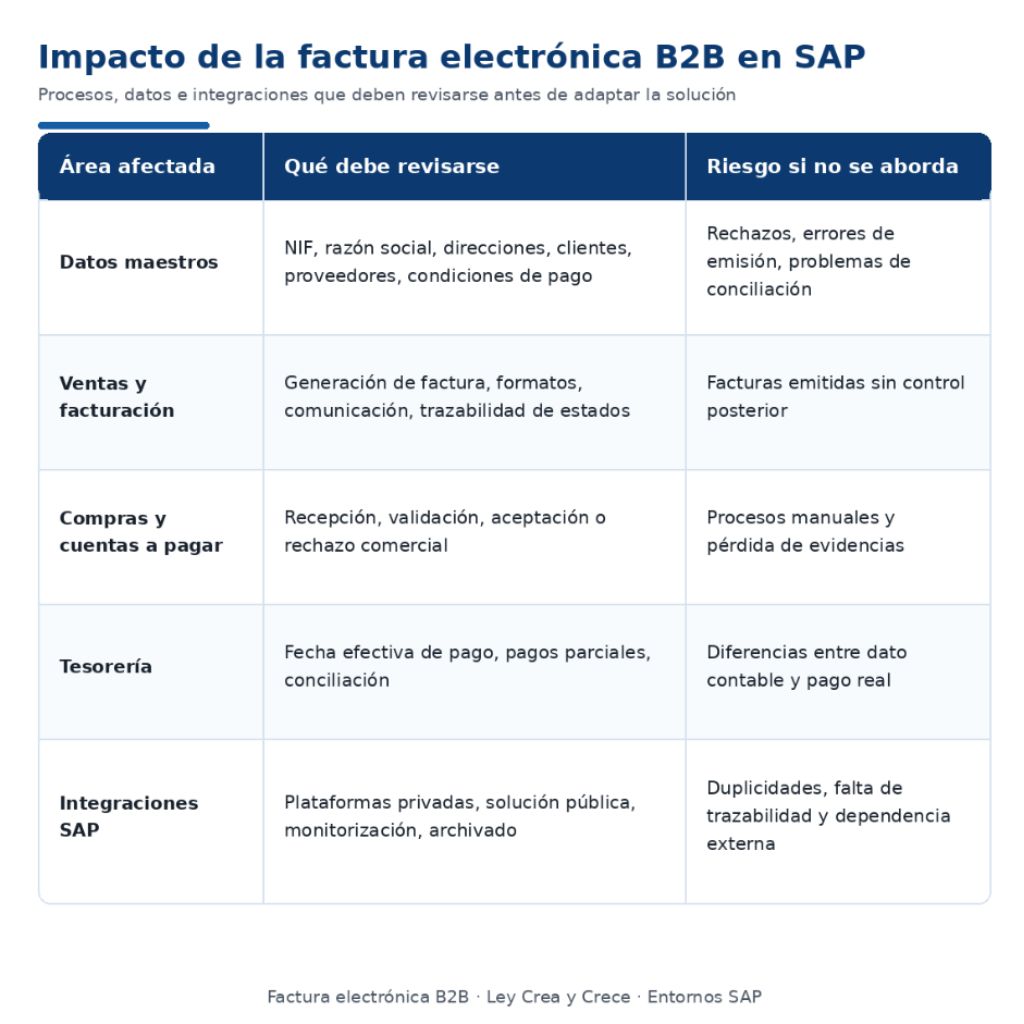
This table summarizes what far too many companies are still failing to consider. The problem isn’t just about “sending XML.” The problem lies in aligning electronic invoicing with the company’s operational reality.
In a mature SAP environment, each invoice is part of a process chain. It may originate from a purchase order, be linked to a delivery, depend on a goods receipt, generate a journal entry, trigger an approval, cause an issue, or result in a payment. If the e-invoicing solution in SAP does not understand that chain, compliance becomes fragile.
SAP ECC and S/4HANA: Two Different Realities
Another common mistake is treating all SAP companies the same. They are not.
Organizations already running SAP S/4HANA may have more options for evolving toward modern architectures, automation, analytics, and cloud services. But many companies continue to operate on SAP ECC, with in-house customizations, legacy interfaces, highly customized processes, and dependencies that cannot be replaced overnight.
That’s why a good SAP e-invoicing strategy shouldn’t impose a one-size-fits-all solution. It should start with specific questions:
Where are invoices generated today? Which companies are affected? Which countries or territories are involved? What is the volume of invoices issued and received? Which processes are automated, and which are still manual? Which solution is used for SII, TicketBAI, Batuz, or Veri*Factu? Which part of the cycle do you want to manage within SAP, and which part outside of it?
A technological solution only makes sense after that analysis.
Bidalnet. The Value of an Integrated Solution
In this context, the i3s proposal with Bidalnet should not be presented as merely a tool for issuing electronic invoices. That message falls short and competes on the wrong front.
The value lies in offering an integrated SAP solution capable of supporting the management of the entire B2B electronic invoice lifecycle: issuance, receipt, communication, status management, acceptance or rejection, effective payment date, and traceability. The key difference isn’t just technological—it’s about process knowledge.
i3s brings expertise in real-world tax compliance and electronic invoicing projects in Spain, including TicketBAI, Batuz, SII, and Veri*Factu, as well as in-depth knowledge of SAP environments. This combination is key, because B2B electronic invoicing lies right at the intersection of regulations, systems, and financial operations.
For a company using SAP, choosing a solution without understanding its internal impact can be costly: duplicate processes, manual tasks, loss of traceability, reliance on external tools, and difficulties in adapting as technical requirements change.
If your company uses SAP, the first step shouldn’t be to request a demo. It should be to assess the actual impact of the Crea y Crece Act on your B2B electronic invoicing processes.
What Should a Company Using SAP Do Now?
Preparation should begin with a thorough assessment. There’s no need to overreact, but we must stop viewing this issue as a minor compliance project.
A company using SAP should review at least five areas: the map of affected companies and processes; the quality of customer and supplier master data; the current invoice issuance and receipt workflow; the management of invoice acceptance, rejection, and payment; and the integration architecture with platforms, public solutions, and internal systems.
The priority isn’t to rush. The priority is to avoid poor construction.
B2B electronic invoicing will force many companies to review how they manage their invoices from start to finish. The Crea y Crece Law and its implementing regulations should not be interpreted solely as a documentation requirement, but rather as an opportunity to streamline financial processes, reduce manual tasks, and improve traceability within SAP.
For companies using SAP ECC or SAP S/4HANA, the important question isn’t just which solution enables compliance. The right question is which architecture enables compliance without disrupting operations, without duplicating processes, and without losing control over data.
That’s where i3s can add value: by combining regulatory expertise, tax experience in Spain, SAP proficiency, and a solution like Bidalnet, designed to integrate into the company’s actual work environment.
B2B electronic invoicing isn’t something you put together at the last minute. You prepare it by first understanding what changes within SAP.

Patricia Martínez Ruiz
SAP FI & S/4HANA Cloud Consultant | Financial Process Optimization & Regulatory Compliance | SAP Certified Professional in i3s