Patricia Martínez Ruiz
B2B electronic invoicing in Spain is no longer just a regulatory concept. The Crea y Crece Act amended Law 56/2007 to require that all businesses and professionals issue, send, and receive electronic invoices in their commercial dealings with other businesses and professionals. In addition, both the issuer and the recipient must provide information regarding the invoice’s status.
But there is an important caveat: just because the requirement is included in the regulation does not mean that all companies must already be operating under the new technical system. Royal Decree 238/2026 implements Spain’s mandatory electronic invoicing system for businesses and professionals, establishes technical and information requirements, and regulates aspects such as private platforms, public solutions, interoperability, and invoice statuses. The Tax Agency announced its publication in the Official State Gazette (BOE) on March 31, 2026.
This point is key to avoiding hasty decisions. The framework has been approved, but its effective implementation has been deferred until a ministerial order takes effect, which is intended to specify the technical details of the public solution. The compliance deadlines will begin once that order is issued: twelve months for companies with a turnover exceeding eight million euros and twenty-four months for all others.
To put it simply: It’s not a good idea to wait, but it’s also not a good idea to communicate or make decisions as if everything were already settled.
The actual schedule. The date isn't the only problem
Many companies are focusing the discussion on a question that’s too narrow: “When will it become mandatory?” It’s a logical question, but it doesn’t go far enough.
The timeline matters, of course. However, for a company using SAP ECC or SAP S/4HANA, the risk isn’t just about missing a deadline. The risk lies in discovering too late that electronic invoicing affects processes that weren’t ready: incomplete master data, approval workflows that are difficult to trace, rejections handled via email, partial payments not linked to the required information, or external integrations without clear governance.
Preparation should begin before the regulatory clock is formally set in motion. Not to overreact, but to buy time for decisions that cannot be resolved in just a few weeks: architecture, data, processes, integration, and testing.
If your company uses SAP, now is the time to conduct an B2B e-invoice impact analysis before deciding on the technology, platform, or integration model.
What obligations does the system introduce?
The Spanish electronic invoicing system does not merely replace PDF with a structured format. Royal Decree 238/2026 defines a model consisting of private electronic invoice exchange platforms, the public electronic invoicing solution, and the possible combination of both approaches. It also establishes requirements for interoperability, interconnection, and the communication of information associated with invoices.
This has practical implications. Companies will need to consider how they issue and receive invoices, how they identify their point of entry, how they interact with private platforms, and how certain statuses are communicated. In SAP environments, this requires reviewing the connection between invoicing, purchasing, accounts payable, accounts receivable, and treasury.
This requirement should not be interpreted as a one-time administrative procedure. It is a new operational layer added to the entire invoice cycle.
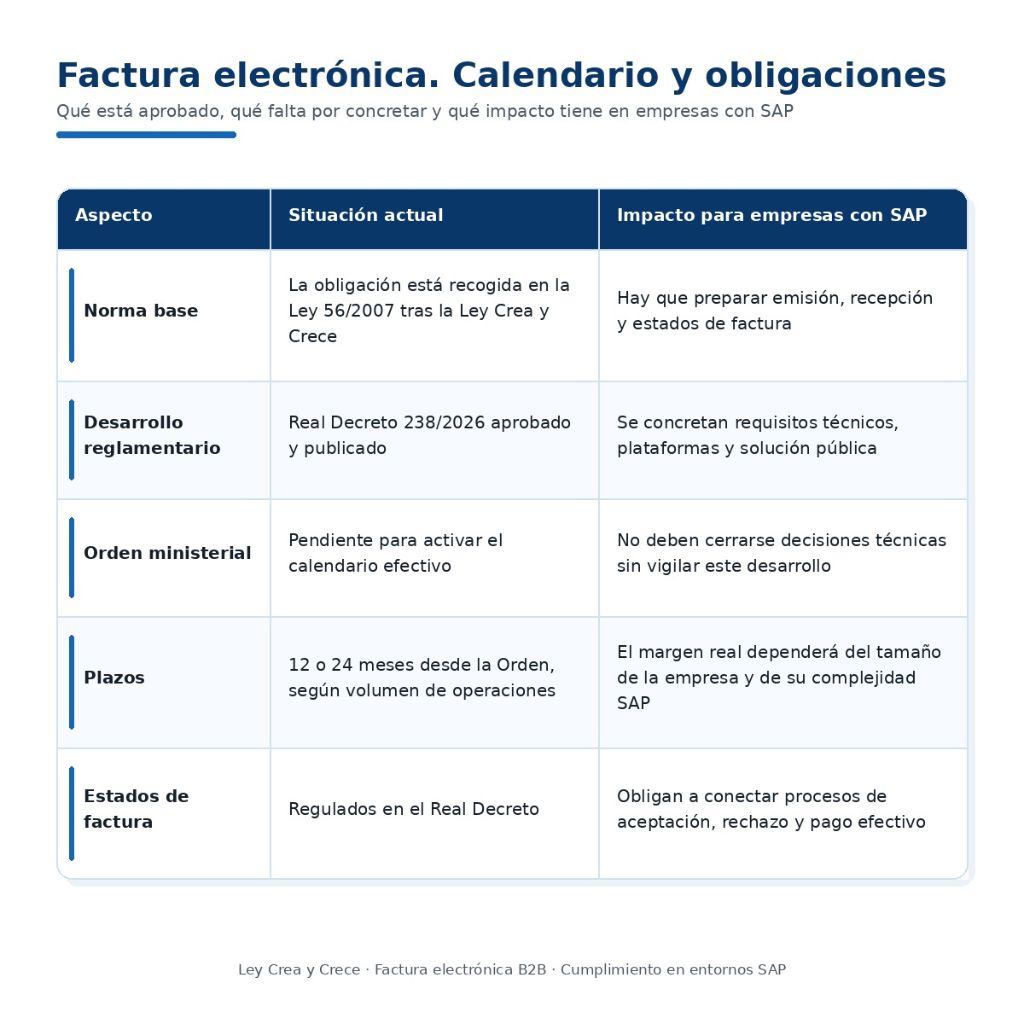
Invoice Status. What's Happening
This table summarizes what far too many companies are still failing to consider. The problem isn’t just about “sending XML.” The problem lies in aligning electronic invoicing with the company’s operational reality.
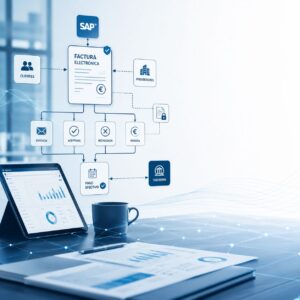
In a mature SAP environment, each invoice is part of a process chain. It may originate from a purchase order, be linked to a delivery, depend on a goods receipt, generate a journal entry, trigger an approval, cause an issue, or result in a payment. If the e-invoicing solution in SAP does not understand that chain, compliance becomes fragile.
SAP ECC and S/4HANA: Two Different Realities
The most challenging part won’t necessarily be generating an electronic invoice. Many organizations have already worked with SII, TicketBAI, Batuz, Veri*Factu, or digital invoicing platforms. The real challenge lies in managing the entire lifecycle of the invoice.
The Royal Decree stipulates that recipients must report whether the invoice has been accepted or rejected for commercial purposes and whether full payment has been made, including the date of payment. It also allows for the reporting of additional statuses, such as partial acceptance or rejection, partial payment, or the assignment of the invoice to a third party. This information must be submitted within a maximum of four calendar days—excluding Saturdays, Sundays, and national holidays—from the time the corresponding status occurs.
This is where the real problems begin.
It is one thing to post an invoice. It is quite another to know whether it has been commercially accepted, whether it has been rejected, whether the rejection has been documented, whether it has been partially paid, whether the actual payment date matches the expected date, or whether the information can be reliably communicated to the relevant system.
In many companies, that data isn’t stored in a single location. Some of it is in SAP, some in banks, some in internal approval processes, some in emails, and some in spreadsheets. This fragmentation is incompatible with robust B2B electronic invoice management.
Before implementing a solution, review how your organization currently handles acceptance, rejection, partial payment, and the effective payment date. That’s where the weaknesses will become apparent.
Public solutions and private platforms
The Spanish model provides for both private platforms and a public electronic invoicing solution. The AEAT will be the agency responsible for developing and managing this public solution, which must also enable the issuance of invoices, the generation of status reports—including confirmation of full payment—and the provision of such information to counterparties and the government.
This does not mean that all companies will operate the same way. Some will opt for private platforms. Others may use the public solution. And many medium and large organizations will need a combination of systems, integrations, and internal processes to ensure their operations continue uninterrupted.
For an SAP company, the question shouldn’t just be “which platform do we use?” The right question is a more challenging one: which model allows for traceability, data control, automation, and the ability to adapt to regulatory changes?
Why SAP Changes the Complexity of the Project
In companies that use SAP, electronic invoicing is not a standalone process. It is linked to customer and vendor master data, sales documents, received invoices, purchase orders, goods receipts, accounting, approval, payments, reconciliation, and financial reports.
For this reason, a superficial adaptation can create more work than it solves. If the chosen solution requires managing statuses outside of SAP, duplicating validations, manually reconciling payment information, or relying on external processes, the company may technically comply but operate less efficiently.
The goal should not be merely to “comply.” It should be to comply without compromising the process.
This is where i3s can offer a unique perspective. Our experience in SAP environments, combined with previous projects related to SII, TicketBAI, Batuz, and Veri*Factu, allows us to view B2B electronic invoicing for what it truly is: a project focused on compliance, integration, and financial processes.
What Companies Should Do Now
A company that wants to prepare itself wisely should start with an impact assessment—not a hasty purchase.
This assessment should review the affected companies, the volume of invoices issued and received, current approval processes, the quality of master data, incident management, the SAP architecture, existing integrations, and the level of payment automation. It should also identify which part of the cycle will be managed within SAP and which part will be delegated to external platforms or services.
i3s can support companies using SAP ECC and SAP S/4HANA in developing a roadmap for transitioning to B2B electronic invoicing, combining regulatory analysis, financial processes, and technology integration.
B2B electronic invoicing in Spain now has a clear framework: there is a legal requirement, supporting regulations, and a timeline that will take effect once the pending ministerial order is issued. But it would be a mistake to reduce the issue to a single date.
For companies using SAP, the critical issue is how to prepare their processes, data, and integrations to manage the entire invoice lifecycle: issuance, receipt, acceptance, rejection, actual payment, traceability, and status reporting.