
Bastien Dupessey
Corporate changes are a common part of business life. Acquisitions, new subsidiaries, spin-offs, joint ventures, and international expansion are increasingly common developments in organizations seeking to grow, adapt to the market, or restructure their operations. However, while the business strategy is moving forward at a rapid pace, the ability of systems to keep pace with these changes remains one of the main challenges to ensuring efficient and sustainable integration.
While management teams focus their attention on strategy, synergies, or growth opportunities arising from these changes, there is one issue that ultimately determines the success of any corporate change: the ability to quickly integrate the new business reality into the group’s management processes and systems.
Experience shows that closing a corporate transaction is usually much faster than integrating the resulting organization. It is precisely at that moment that technology shifts from being a supporting element to becoming a critical factor in ensuring that the company can operate efficiently, maintain control, and continue to move forward at the pace the business demands.
When Growth Meets Systemic Limits
Acquiring a new company, establishing a subsidiary in another country, or spinning off a business unit often presents a common challenge: launching a new operating entity without compromising corporate governance or visibility.
In many cases, organizations face a complex dilemma. On the one hand, extending the corporate ERP system to a new subsidiary can involve lengthy, costly projects that are difficult to justify, especially when it comes to small or medium-sized subsidiaries. On the other hand, allowing each entity to continue working with local solutions or legacy systems can lead to integration problems, inconsistencies in information, and a gradual loss of control over processes.
The result is a situation that many companies are all too familiar with. The new entity begins operations using tools that differ from those of the rest of the group; financial processes require manual tasks to consolidate information; master data is duplicated; and temporary integrations end up becoming permanent solutions. What initially seemed like a pragmatic decision ends up creating operational complexity that limits the potential for future growth.
This reality becomes particularly relevant in a business context where speed is a competitive factor. Organizations need their systems to keep pace with the evolution of the business, rather than becoming an obstacle every time a structural change occurs.
The Need for a More Flexible Technology Strategy
As business structures become more complex, many organizations are reevaluating the traditional approach they have historically used to manage their ERP systems.
The idea of implementing the same solution—with the same functional scope and the same level of complexity—across all companies in the group is not always the most efficient option. The needs of a multinational parent company are often very different from those of a newly acquired subsidiary, a joint venture, or a new company created to operate in a specific market.
For this reason, more and more companies are adopting strategies that allow them to combine corporate standardization with the flexibility needed to address the specific needs of each entity. In this context, the model known as Two-Tier ERP is gaining significant traction.
Two-Tier ERP: Balancing Control and Agility
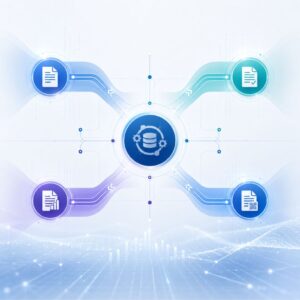
The Two-Tier ERP strategy is based on a simple yet extremely effective principle: allowing the corporate headquarters and the various subsidiaries to use solutions tailored to their operational needs, while maintaining strong integration that ensures data consistency and alignment with the group’s processes.
Under this model, the organization maintains a central system that serves as the corporate hub for strategic, financial, and governance processes. At the same time, the subsidiaries have a cloud-based ERP system designed to respond quickly to their operational needs, benefiting from a more agile implementation and reduced technological complexity.
Far from creating silos, this approach connects both levels through integrated processes, information sharing, and consolidation mechanisms that ensure a comprehensive view of the business. The result is an organization capable of maintaining corporate control without sacrificing the speed required by corporate changes.
This ability to combine governance and agility explains why the Two-Tier ERP model has become one of the most highly valued strategies among corporate groups undergoing expansion, post-acquisition integration, or corporate reorganization.
The Role of SAP GROW in the Two-Tier Strategy
The rise of cloud models has opened up new possibilities for organizations seeking to accelerate the launch of new entities without undertaking lengthy implementation projects.
In this context, SAP GROW is positioned as a particularly well-suited solution for two-tier ERP environments. Based on SAP S/4HANA Cloud Public Edition, it enables the deployment of a modern, standardized ERP system that is ready to scale, leveraging preconfigured business processes and methodologies that significantly reduce implementation times.
For companies, this means having a solution capable of supporting the evolution of their business from the very beginning. A new subsidiary can be integrated into the corporate technology ecosystem in a fraction of the time traditionally required for this type of project, while maintaining integration with headquarters and taking advantage of the benefits of a cloud platform.
In addition to rapid deployment, SAP GROW offers other benefits that are particularly relevant in business transformation scenarios. Continuous feature updates, reduced infrastructure maintenance costs, the adoption of best business practices, and the ability to scale as the organization’s needs evolve make this solution a particularly attractive option for corporate groups seeking to gain flexibility without losing control.
An opportunity to redefine the technology strategy
Added to this scenario is a factor that is driving strategic reflection in many organizations: the impending end of standard support for SAP ECC.
For many companies, this milestone represents not only the need to evolve technologically, but also an opportunity to rethink how they manage their enterprise application ecosystem. Decisions related to migrations, system modernization, or the adoption of new solutions often coincide with expansion, acquisitions, or corporate reorganization.
From this perspective, the Two-Tier ERP strategy allows both challenges to be addressed in a complementary manner. As the organization defines its roadmap for the future, it can continue to integrate new entities quickly and in a controlled manner, ensuring that corporate changes are not held back by large-scale technology transformation projects.
Preparing for an Ever-Changing Business Environment
The question is no longer whether organizations will have to face new corporate changes in the future. Experience shows that these processes are a natural part of business evolution and that they will continue to occur with greater frequency in the coming years.
What really matters is having a technology strategy capable of keeping pace with these changes without creating unnecessary complexity or slowing down the business’s ability to execute.
Companies that succeed in combining agility, integration, and control will be better prepared to capitalize on new growth opportunities, integrate acquisitions more quickly, and adapt to an environment where the ability to transform has become a competitive advantage in and of itself.
In this context, the combination of a two-tier ERP strategy and cloud solutions such as SAP GROW represents much more than a technological decision. It is a way to ensure that systems evolve at the same pace as the business and that technology acts as a catalyst for change, rather than becoming a barrier to growth.